
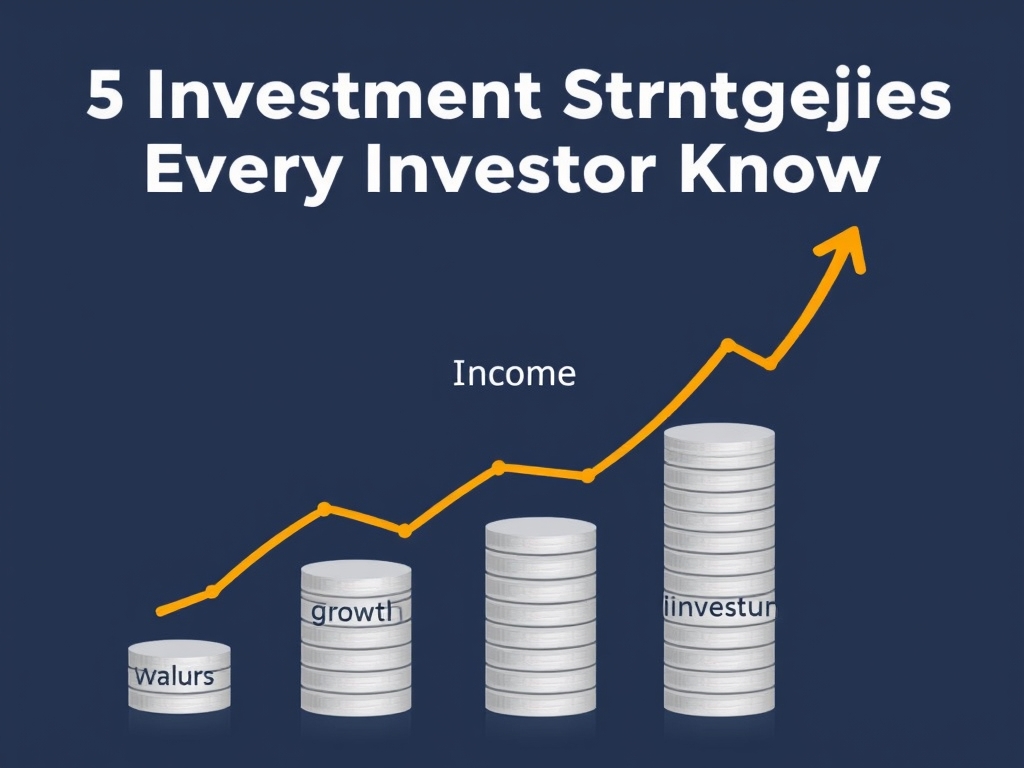
5 Investment Strategies Every Investor Should Know: Value, Growth, Income, Momentum, and Contrarian Investing
Mastering the Markets: 5 Core Investment Strategies for Success
Are you looking to take control of your financial future but feel overwhelmed by the sheer volume of market noise? You are certainly not alone in this journey, as even the most seasoned investors often grapple with finding the right path toward long-term wealth accumulation. In this post, we will break down five essential investment strategies that act as the pillars of a robust financial portfolio: Value, Growth, Income, Momentum, and Contrarian investing. Think of these strategies as different tools in your financial toolkit, each designed to handle specific market conditions and personal risk tolerances. By understanding how these approaches work, you can stop guessing and start building a strategy that actually aligns with your goals. Let’s dive deep into the mechanics of these methods to help you navigate the complex world of finance with confidence and clarity. Whether you are a beginner or a veteran trader, these concepts remain the bedrock of successful portfolio management in today’s economy.

1. Value Investing: Finding Diamonds in the Rough
At its core, Value Investing is the art of buying stocks that are trading for less than their intrinsic value—essentially, buying a dollar for 50 cents. Famous investors like Warren Buffett have popularized this approach, focusing on companies that are undervalued by the market due to temporary setbacks or general neglect. To succeed here, you must conduct thorough fundamental analysis to understand a company’s financial health, debt levels, and competitive advantage. Key indicators to watch include:
- Low Price-to-Earnings (P/E) ratios
- Strong dividend history
- Solid cash flow statements
By ignoring short-term market volatility, value investors wait patiently for the market to realize the true worth of their holdings. It requires discipline, patience, and the ability to ignore the hype surrounding trendy tech stocks. When the rest of the world is selling, a true value investor is often busy researching the next hidden gem that offers long-term stability and consistent growth potential for a bargain price.

2. Growth, Income, and Momentum: The Dynamic Trio
Growth investing is all about future potential; it targets companies expected to grow at an above-average rate, often reinvesting earnings into expansion rather than paying dividends. On the other hand, Income Investing is the strategy of choice for those seeking regular, predictable cash flow, often through dividend-paying stocks, bonds, or real estate investment trusts (REITs). It provides a sense of security and liquidity that growth stocks simply cannot offer during market downturns. Meanwhile, Momentum Investing takes a different path entirely, banking on the idea that an asset moving in one direction will likely continue to do so in the near future. These investors look for strong trends and jump on the bandwagon while the momentum is high. While growth and income provide long-term stability, momentum is a high-octane strategy that requires careful monitoring and quick decision-making. Balancing these three can provide a portfolio with a healthy mix of aggression, safety, and market responsiveness.
3. Contrarian Investing: Defying the Herd Mentality
Finally, we have Contrarian Investing, the bold strategy of going against the prevailing market sentiment. When the majority of investors are fearful and selling, the contrarian is buying, and when the market is euphoric and buying at peak prices, the contrarian is often selling. This approach is rooted in the psychological observation that market trends are often driven by fear and greed rather than rational analysis. To implement this, you must develop a thick skin and a willingness to be wrong in the short term for the sake of long-term gains. It is not just about being different for the sake of it; it is about recognizing when the herd has overreacted to news or economic data. By maintaining a objective perspective, you can find opportunities that others have missed because they were too busy panicking or chasing the latest headline. It is arguably the most challenging strategy to execute emotionally, but it has historically provided some of the greatest alpha for those brave enough to stick to it.