
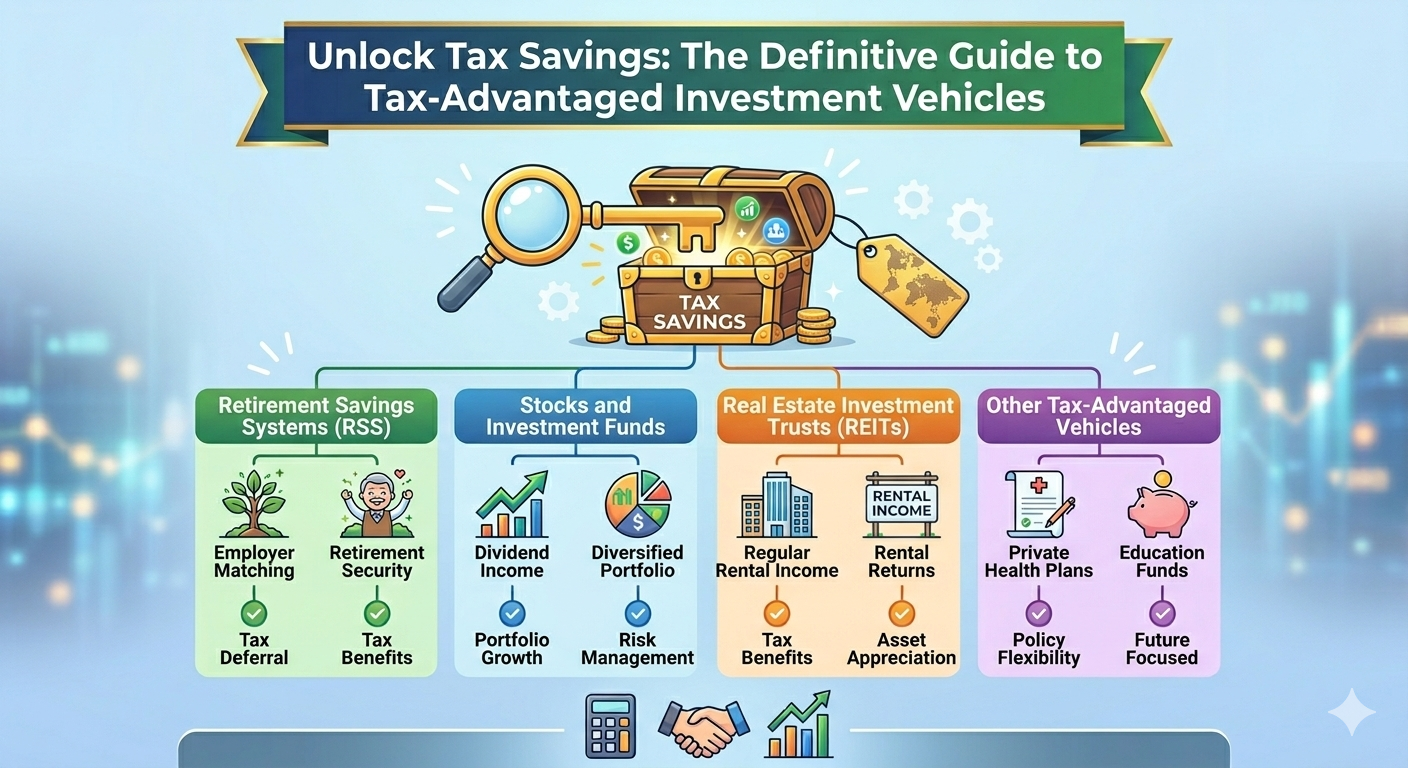
Unlock Tax Savings: The Definitive Guide to Tax-Advantaged Investment Vehicles
Did you know that over a 30-year investment horizon, taxes can quietly erode nearly 40% of your potential wealth? While most investors obsess over annual returns and market volatility, the savvy minority focuses on a more predictable metric: tax efficiency. In the world of wealth building, it’s not just about how much you make; it’s about how much you actually keep after Uncle Sam takes his cut.
The current economic landscape, marked by fluctuating tax brackets and evolving legislation, makes understanding tax-advantaged vehicles more critical than ever. Whether you are a high-earner looking to shield your income or a young professional starting your journey, leveraging the right accounts can be the difference between a comfortable retirement and a strained one. This guide explores the most powerful tax-advantaged tools available today, helping you build a roadmap for maximum long-term growth.
1. The Pillars of Retirement: Traditional vs. Roth Accounts
Retirement accounts are the foundation of tax-efficient investing. However, the choice between “tax-now” or “tax-later” determines your future liquidity and total tax liability. Understanding the mechanics of these vehicles is the first step toward strategic wealth preservation.
The Power of Tax-Deferred Growth: Traditional 401(k) and IRAs
Traditional 401(k)s and Individual Retirement Accounts (IRAs) offer an immediate “win” for your wallet. When you contribute to these accounts, your contributions are typically tax-deductible, effectively lowering your taxable income for the current year.
- Immediate Savings: If you are in the 32% tax bracket and contribute $20,000 to a 401(k), you could save $6,400 in federal taxes immediately.
- Compounding Efficiency: Because the money is not taxed while it remains in the account, your dividends and capital gains reinvest in their entirety, accelerating the compounding process.
- The Trade-off: You will pay ordinary income tax on these funds when you withdraw them in retirement. This is ideal for those who expect to be in a lower tax bracket during their golden years.
The Tax-Free Legacy: Roth 401(k) and Roth IRAs
In contrast, Roth accounts flip the script. You contribute after-tax dollars today in exchange for tax-free growth and tax-free withdrawals in the future. This is arguably the most powerful wealth-building tool in the U.S. tax code.
With a Roth IRA, every dollar of growth—even if your $10,000 investment grows to $1,000,000—is yours to keep without a penny going to the IRS, provided you meet the holding period requirements. For younger investors with decades of growth ahead, the Roth structure is often superior because the value of the tax-free growth far outweighs the initial tax deduction of a traditional account.
2. The “Triple Tax Advantage”: Health Savings Accounts (HSAs)
While often categorized as “health insurance tools,” the Health Savings Account (HSA) is secretly one of the most potent investment vehicles available. It is the only account that offers a triple tax advantage, making it even more efficient than a 401(k) or a Roth IRA.
To qualify for an HSA, you must be enrolled in a High Deductible Health Plan (HDHP). Once you have the account, you can enjoy these three benefits:
- Tax-Deductible Contributions: Much like a Traditional IRA, money goes in pre-tax, reducing your current tax bill.
- Tax-Free Growth: Any interest or investment gains earned within the HSA are not subject to taxes.
- Tax-Free Withdrawals: As long as the money is used for qualified medical expenses, you pay zero taxes on withdrawals.
The Pro Strategy: Many high-net-worth investors use the HSA as a “stealth IRA.” Instead of using the funds for current medical bills, they pay for health expenses out-of-pocket, keep the receipts, and let the HSA funds remain invested in the stock market for decades. After age 65, the HSA functions like a Traditional IRA for non-medical expenses (taxed as income), while remaining tax-free for medical needs. This flexibility is unmatched in the financial world.
3. Education Savings and the 529 Plan Revolution
For parents and grandparents, the 529 Plan has long been the gold standard for college savings. However, recent legislative changes (such as the SECURE Act 2.0) have transformed these plans into versatile multi-generational wealth tools.
A 529 Plan allows you to contribute after-tax money that grows tax-deferred and can be withdrawn tax-free for qualified education expenses, including tuition, room, board, and even up to $10,000 for K-12 tuition.
New Flexibility: The Roth IRA Rollover
One of the biggest historical deterrents to 529 plans was the fear of “overfunding”—what happens if the child doesn’t go to college or gets a full scholarship? As of 2024, beneficiaries can now roll over up to a lifetime limit of $35,000 from a 529 plan into a Roth IRA (subject to certain conditions and annual limits). This eliminates the “penalty trap” and allows parents to jumpstart their children’s retirement savings if college funds aren’t fully utilized.
4. Strategic Tax Management: Municipal Bonds and Harvesting
Beyond specific account types, savvy investors use specific asset classes and accounting strategies to minimize their annual tax “drag.” This is particularly important for funds held in standard taxable brokerage accounts.
Municipal Bonds: The Tax-Exempt Income Stream
For investors in high tax brackets, Municipal Bonds (issued by states, cities, or counties) offer a unique advantage: the interest income is generally exempt from federal income tax. If you live in the state where the bond was issued, it is often exempt from state and local taxes as well—a “double-tax-free” benefit.
While the nominal yield on a municipal bond might look lower than a corporate bond, the Tax-Equivalent Yield is often higher for those in the 35% or 37% federal brackets. It is a way to generate income without pushing yourself into an even higher tax liability.
Tax-Loss Harvesting: Turning Lemons into Lemonade
Tax-loss harvesting is the practice of selling an investment that is trading at a loss to offset capital gains realized elsewhere in your portfolio. If your losses exceed your gains, you can use up to $3,000 of the excess loss to offset your ordinary income. Any remaining losses can be carried forward to future years.
By systematically “harvesting” these losses, you essentially force the IRS to share in your investment risks, lowering your overall tax bill and allowing more of your capital to remain invested and compounding over time.
5. Real Estate and the 1031 Exchange
Real estate remains one of the most tax-favored asset classes in the United States. While homeowners enjoy the primary residence exclusion, real estate investors have access to a powerful tool known as the Section 1031 Exchange.
Under a 1031 exchange, an investor can sell an investment property and reinvest the proceeds into a “like-kind” property while deferring all capital gains taxes. This allows investors to “swap ’til they drop”—continually trading up for larger, more profitable properties without losing 20-25% of their equity to taxes at every step.
Furthermore, if these properties are held until death, heirs receive a “step-up in basis.” This means the capital gains tax that was deferred for decades effectively disappears, providing a massive tax-free wealth transfer to the next generation.
Conclusion: Building Your Tax-Efficient Fortress
Maximizing your wealth is a two-front war: you must earn high returns while simultaneously minimizing the “leakage” caused by taxes. There is no one-size-fits-all strategy; the ideal mix of 401(k)s, Roth IRAs, HSAs, and real estate depends on your current income, your age, and your future goals.
Actionable Takeaway: Start by maximizing your employer match in your 401(k)—that’s a 100% immediate return. Next, look toward the HSA if you are eligible, then fill your Roth or Traditional IRA buckets. Finally, ensure your taxable brokerage account is managed with an eye toward tax-loss harvesting and municipal bonds.
Tax laws are complex and subject to change, so it is always wise to consult with a tax professional or financial advisor. However, by taking control of these tax-advantaged vehicles today, you aren’t just saving money—you are buying your future financial freedom at a significant discount.